
My work has always tried to unite the true with the beautiful and when I had to choose one or the other, I usually chose the beautiful.
Hermann Weyl
Sample Research Projects

Interesting Graph Skeletons
Advisors: Robert Rose and Karen L. Collins (Wesleyan University)
I designed an Alloy code which proves that every interesting cubic graph has at least fourteen vertices. This was a continuation of a final project for COMP360A: Introduction to Automated Reasoning taught by Robert Rose at Wesleyan University during the fall semester of 2025. I was motivated by how strenuous of a task it was to write my paper "Every Interesting Cubic Graph Has at Least Fourteen Vertices: A Revised Proof" in which I revised a proof found in the paper "Girth Six Cubic Graphs Have Petersen Minors" by Neil Robertson, Paul D. Seymour, and Robin Thomas.
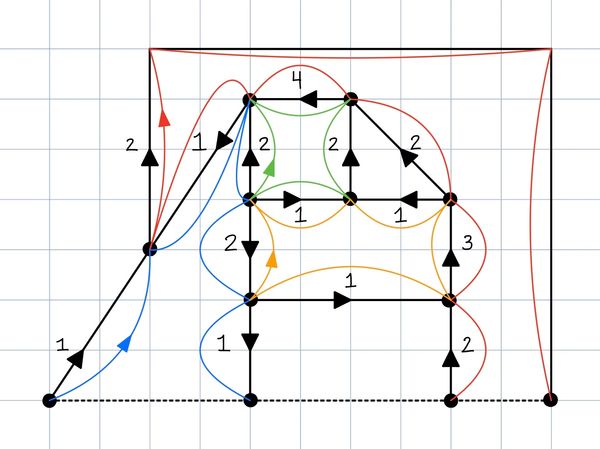
Stranding SL_n Webs
Advisor: Juliana Tymoczko (Smith College)
The subject matter of my research was SL_n webs are planar directed graphs with a boundary. The boundary vertices have 1 edge while non-boundary vertices have 3 edges, edges are labeled with an integer modulo n, and adjacent edges of non-boundary vertices satisfy an algebraic constraint on their direction and label. Strands are colored directed paths with an associated n-length bit string through the graph. A stranding of a SL_n web is a collection of strands such that no two strands of the same color intersect, every edge has at least one strand, and the strands satisfy an algebraic constraint along each edge. Stranding is a new concept and has many open questions. The self designed goal of this project was to develop an algorithm that inputs an Sl_n web and outputs a valid stranding of the SL_n web.

2-Caps in the Game of EvenQuads
Advisor: Lauren Lynn Rose (Bard College)
Collaborator: Darrion Thornburgh (Vanderbilt University)
The subject matter of our research was EvenQuads, a variant of the popular card game SET®, which was developed by Lauren Rose and Jeffrey Pereira and published by the Association for Women in Mathematics. A Quad is a set of 4 cards that satisfy a certain pattern. The self designed goal of this project was to find and classify collections of cards that do not contain a Quad, called 2-caps. In particular, for each nonnegative integer k, we classified 2-caps that contain k distinct triples of cards in the 2-cap that determine the same fourth card. This game is modeled by the affine geometry AG(n,2), allowing us to study this problem in higher dimensions.

Parking Garage Functions
Advisor: Lauren Lynn Rose (Bard College)
The self selected subject matter of my research was about an introduced generalization of parking functions called parking garage functions. Parking garage functions are sequences that represent the parking garage level preferences of cars which lead to all cars parking on a level after a systematic placement. The self designed goal of this project was to find a closed and recursive formula for the number of sequences that are a parking garage function. I found a closed formula for the number of sequences in a subset of parking garage functions, descending parking garage functions, via a bijection between descending parking garage functions and Dyck paths. Dyck paths are paths on a rectangular grid which only take right and upward steps starting at the origin and remain under a positively sloped diagonal that goes through the origin. I also found a recursive formula for the number of sequences that are a parking garage function.